Spells, Monsters & Effects
Supported spells, creature abilities, feats, and weapon masteries use Foundry’s native items, with choices and follow-up rolls available from chat.
Spells
Defensive spells
- Shield. Use it on an eligible hit to recheck the same attack against your new AC. The card keeps the original attack dice.
- Counterspell. Respond to an opposing spell declaration from chat. Resolve the native Constitution save and any counter to the Counterspell before the original cast continues.
- Mirror Image. Casting can apply the three duplicates together. On an eligible hit, use the card to roll for interception without spending a Reaction.
Damage and targeting
- Hex. Choose the affected ability on the curse card. Its bonus damage joins the damage roll against the recorded Hex target.
- Hunter’s Mark. Track the marked creature and add the spell’s damage to eligible hits against it.
- Conjure Minor Elementals. Choose the damage type for the extra damage on an eligible hit against a target in the spell’s area.
- Eldritch Blast. Choose a target for each beam. The module tracks the remaining attacks from the same cast.
- Scorching Ray. Roll each ray against a chosen target without casting again. Each ray keeps its own attack and damage result.
- Fly. Apply the spell’s configured buff to eligible recipients, including additional targets from upcasting.
Monster Abilities
Repeat saves
- Harpy · Luring Song. Prompts the victim’s end-of-turn Wisdom save to end the tracked effects.
- Chasme · Drone. Prompts the victim’s end-of-turn Constitution save to end Unconscious.
- Faerie Dragon · Euphoria Breath. Prompts repeat Wisdom saves for the tracked Incapacitated effect.
- Revenant · Vengeful Glare. Prompts repeat saves for the linked fear and paralysis effects.
- Sphinx of Valor · Second Roar. Prompts an end-of-turn Wisdom save against its paralysis.
Escapes and recurring damage
- Constrict. Supported sources, including the Giant Constrictor Snake and Marilith, offer escape checks tied to the original grappler.
- Swallow. Supported creatures such as the Giant Toad and Purple Worm track the swallowed victim and prompt recurring damage from that source.
- Stirge · Proboscis. Prompts recurring damage from the attached Stirge on its turn.
- Water Elemental · Whelm. Prompts recurring Bludgeoning damage for creatures tracked by that Elemental’s grapple and restraint.
- Animated Rug of Smothering · Smother. Prompts damage at the victim’s turn start and offers an optional escape check.
- Djinni · Create Whirlwind. Prompts start-of-turn Thunder damage and the restrained creature’s end-of-turn Strength save.
- Infernal Wounds. Tracks ongoing HP loss and treatment by the originating wound.
Auras
- Pit Fiend · Fear Aura. Prompts eligible enemies’ Wisdom saves and tracks successful-save immunity against that Pit Fiend.
- Ghast, Hezrou, and Troglodyte · Stench. Prompts Constitution saves and tracks the applicable immunity after success.
- Swarm of Dretches · Fetid Aura. Prompts the Poisoned save for eligible creatures.
- Remorhaz · Heat Aura. Prompts damage for eligible creatures in range at the end of the source’s turn.
- Balor, Azer, and other supported creatures · Fire Aura. Offers the GM a choice of eligible creatures in the area at the source’s turn end.
Persistent Effects & Regions
Creature Effect Triggers
- Fear. Prompts repeat saves with the spell’s line-of-sight check.
- Hold Person and Hold Monster. Prompt repeat saves to end the tracked paralysis.
- Dominate Beast, Person, and Monster. Prompt the linked repeat save when the dominated target takes damage.
- Entangle and Ensnaring Strike. Offer an optional escape action tied to the original cast.
- Web and Evard’s Black Tentacles. Offer optional escape actions alongside their Region triggers.
- Phantasmal Killer and Weird. Resolve the repeat save first, then prompt damage on a failure.
- Melf’s Acid Arrow. Prompts its delayed damage once after a qualifying hit.
- Vitriolic Sphere. Prompts its delayed damage once after a failed initial save.
- Heroism. Refreshes the configured temporary HP at turn start.
- Regenerate. Prompts its recurring turn-start healing separately from the initial heal.
- Blink. Offers the initial roll and later end-of-turn prompts, with a temporary Ethereal effect.
Region recipes
- Moonbeam and Cloudkill. Prompt their configured saves as creatures enter or end a turn in the area.
- Spike Growth. Accumulates damage from movement through the area.
- Spirit Guardians and Conjure Woodland Beings. Attach the area to the caster and handle eligible creatures as the area moves.
- Conjure Animals. Attaches the area to the summoned pack and can share one turn’s save and damage workflow among eligible targets.
- Flaming Sphere. Attaches its area for end-of-turn saves. Move and ram the sphere at the table.
- Guardian of Faith. Tracks the guardian’s damage pool and removes the guardian and its area when the pool runs out.
- Aura of Life. Applies the supported Necrotic resistance while eligible allies are in the attached area.
GMs can edit, disable, or restore built-in recipes. See Region Automation.
Weapon Masteries
Enable individual options under Module Options → Automations → Weapon Masteries. The character needs the mastery unlocked for the weapon.
- Cleave. A qualifying melee hit offers a follow-up attack. Choose a different target and check reach at the table. The extra attack’s damage omits a positive ability modifier.
- Graze. After miss corrections resolve, a confirmed miss can deal damage equal to the attack ability modifier. The damage card supports Apply and Undo.
- Sap. Applying damage from a qualifying hit applies Disadvantage to the target’s next eligible attack. Undo can remove the Sap from that hit.
- Slow. A qualifying hit reduces the target’s Speed by 10 feet until the start of the attacker’s next turn. Repeated applications don’t add to the reduction.
- Topple. Use the hit card to prompt the defender’s Constitution save. On a failure, the card can apply Prone.
- Vex. Applying damage prepares Advantage on your next eligible attack against that target. Apply and Undo manage the linked benefit.
Handle Push and Nick at the table.
Feats and Fighting Styles
Damage and hit effects
- Great Weapon Fighting. Eligible two-handed melee damage dice showing 1 or 2 count as 3.
- Great Weapon Master. Add the proficiency bonus in Damage Configuration on an eligible Heavy-weapon hit made with the Attack action on your turn. Handle Hew at the table.
- Savage Attacker. In Damage Configuration, roll the weapon damage dice twice and keep the higher total. The card shows both rolls and tracks the once-per-turn use.
- Crusher. A qualifying single-target critical hit applies the feat’s Advantage effect against that target. Handle the push at the table.
- Slasher. Applies the Speed reduction on the first qualifying hit each turn and the attack Disadvantage effect on a qualifying critical hit. The automated effects use single-target cards.
- Piercer. Choose one eligible weapon damage die to reroll. On a qualifying critical hit, the extra die is included in the damage roll.
- Elemental Adept. With the native element selected, matching spell damage dice treat 1 as 2 and matching spell damage bypasses Resistance. Immunity still applies.
Defenses and reactions
- Lucky. Spend a Luck Point from an eligible single-target incoming attack card to impose Disadvantage. The module keeps the original dice and respects normal Advantage cancellation.
- Defensive Duelist. Use your Reaction on an eligible melee hit while you have a Finesse weapon equipped. The card rechecks the same attack with the native AC bonus. Critical hits bypass the prompt.
- Mage Slayer. Guarded Mind can turn an eligible failed mental save into a success while keeping the original dice. Concentration Breaker connects qualifying damage to the defender’s concentration save.
Unarmed feats
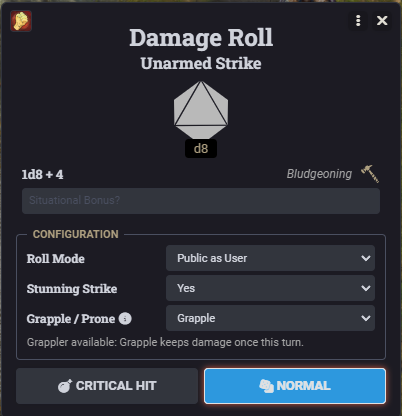
- Grappler. Keep the strike’s damage and attempt a grapple once on your turn when the attack qualifies. See Grappler in Damage Configuration.
- Tavern Brawler. Rerolls 1s on eligible base unarmed damage dice once and keeps each replacement.
Unarmed Combat
- Grapple. Choose Grapple in Damage Configuration on a qualifying unarmed hit. The grapple normally replaces damage. An existing grapple from the same attacker removes the duplicate choice.
- Shove (Prone). Choose Prone in Damage Configuration to replace strike damage with a save against being knocked Prone. Handle shove movement at the table.
- Target save. The target uses its higher Strength or Dexterity save modifier, with Strength on ties. Martial Arts can use Dexterity for the attacker’s DC.
- Grappler and Flurry of Blows. A qualifying strike can keep damage with Grappler once on your turn. Flurry can offer Grapple or Prone in place of damage and leaves the damage-plus-grapple use available. See the damage configuration.
- Escape a grapple. Module-created grapples can offer an optional escape roll at the start of the grappled creature’s turn. A success removes the grapple tied to that source.