Flash of Genius: Add the Artificer’s Intelligence bonus to an eligible failed check or save from chat. Spend the feature use and Reaction.
Spell-Storing Item: Store a spell in an eligible weapon or focus during a Long Rest or from the feature. Its holder casts with separate charges and the Artificer’s casting ability, and maintains concentration when required.
Companion turns: Steel Defenders and other supported companions that act with their owner can stay off the initiative list. Their turn effects and recoverable abilities follow the owner’s turn, while each companion keeps its own Reaction and resources.
Artificer Subclasses
Alchemist: Brew and distribute Experimental Elixirs after a Long Rest. Old unused bottles clear automatically. Alchemical Savant adds its bonus to eligible rolls, and Alchemical Eruption appears after qualifying damage.
Armorer: Suit up and attack with the armor’s weapons using the right Intelligence and enhancement bonuses. Guardian Thunder Pulse marks the creature you hit, discouraging it from attacking your allies, then clears the effect when its duration ends.
Battle Smith: Add Arcane Jolt to a qualifying magic weapon or Steel Defender hit. The Defender can use Deflect Attack during attack declaration to impose Disadvantage. Improved Deflection offers its return damage when available.
Artillerist: Casting through an Arcane Firearm? Add its extra damage while rolling the spell, with the bonus kept to one use per casting. Keep using Foundry’s familiar summon and command controls for your cannons.
Cartographer: Faerie Fire becomes a team tool: outlined enemies offer attack Advantage, and the Cartographer’s qualifying damage includes the Guided Precision choice. The module tracks its turn limit and avoids unnecessary concentration prompts for the protected spell.
Reanimator: Choose companion modifications when summoning. Improved Reanimation upgrades Death Burst. Life Transfer heals the caster with the companion’s remaining HP and centers the burst on the companion. Life Jolt remains manual.
Barbarian
Core Barbarian
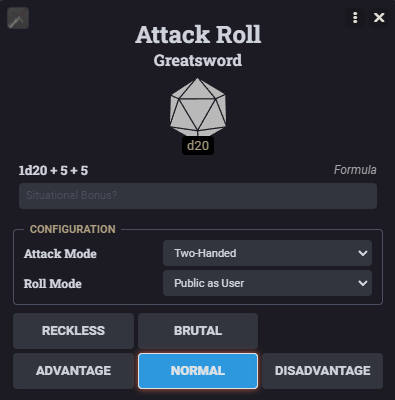
Reckless Attack Choose Reckless during the attack setup. Native D&D5e handles outgoing Advantage. The module manages the linked effect that gives enemies Advantage on incoming attacks.
Brutal Strike Choose Brutal in the attack window to trade Reckless Advantage for a harder, more disruptive hit. The module tracks the turn’s chosen Brutal attack, including when it misses.
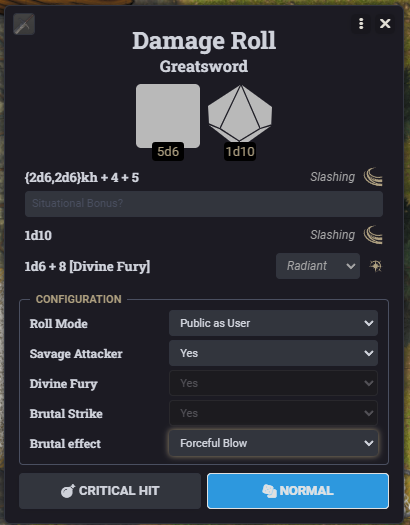
Brutal effects in damage Configuration On a hit, choose the blow’s effect alongside its damage: push, slow, stagger or sunder as your level allows. The extra damage rolls with the weapon, and supported conditions apply and expire for you. Move pushed tokens at the table.
Sundered The next eligible ally’s attack gets the +5 bonus, then consumes the opening whether it hits or misses. Canceling an attack does not waste it.
Staggered The target’s next save receives Disadvantage, while its restriction on Opportunity Attacks remains for the rest of the effect’s duration.
Indomitable Might. Roll a Strength check or save as usual. If the total is below the Barbarian’s Strength score, the module raises it and labels the result.
Primal Knowledge. Starting Rage applies the feature’s native skill benefits. They end with Rage.
Relentless Rage. When a raging Barbarian drops to 0 HP, chat offers the native Constitution save. The module tracks the rising save DC and restores HP on a success. Failing or declining ends Rage.
Persistent Rage. The module keeps Rage active through Incapacitated if you have Persistent Rage. Unconscious still ends it.
Reckless cleanup. Use Reckless every round without filling the sheet with old copies of the same effect.
Berserker
Frenzy Rage, attack recklessly, and roll your first qualifying hit: Frenzy’s extra damage joins the weapon damage automatically, including critical hits.
Mindless Rage. Starting Rage clears Charmed and Frightened and supplies the feature’s protection while Rage lasts.
Intimidating Presence. Frighten nearby enemies, with repeat saves and condition cleanup following the affected creatures. Frenzy’s damage remains part of the normal attack flow.
Zealot
Zealot · Divine Fury While raging, add Divine Fury to your first qualifying hit each turn. Pick Radiant or Necrotic alongside the damage roll; the module adds the right bonus and tracks the use.
Zealot · Fanatical Focus A failed save offers a second chance right on its card. Click to reroll with the Rage bonus; the replacement result is used and the once-per-Rage use is tracked.
Zealot · Zealous Presence Inspire your allies and let the effect handle their attack and save Advantage until your next turn. It stays active across multiple rolls without being consumed by the first attack.
Wild Heart
Choose before Rage. Pick your Wild Heart animal benefits in one window as you start Rage, including the later Power of the Wilds choice. Cancel if you are not ready; no use is spent.
Benefits follow the choice. Your selected animal applies its supported defenses, flight or ally/enemy aura benefits. These stay connected to Rage, so you spend less time swapping effects. Situational movement choices remain yours.
Ram and Aspects. Use the Ram follow-up after a qualifying hit to knock the target Prone. Choose Owl, Panther or Salmon from the Aspect card to replace the previous benefit; daily switching limits remain table-managed.
World Tree
Vitality Surge. Start Rage and receive your Barbarian-level temporary HP immediately, keeping a higher amount if you already have one. Extending the same Rage does not refill it.
Life-Giving Force. Use the feature’s healing action when you need it. Other World Tree choices and decisions about ending temporary HP stay in the players’ hands.
Barbarian card examples
Reckless and Brutal attack buttons. Reckless and Brutal sit directly above the normal attack-mode buttons.Brutal Strike effect selection. Choose the Brutal effect in damage Configuration alongside the weapon damage and other riders.
Bard
Core Bard
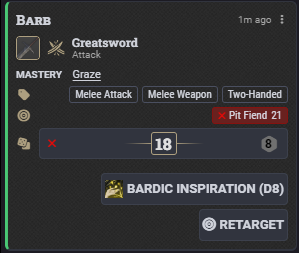
Bardic Inspiration Give Inspiration, then let the recipient use it from a failed attack, save or check card. The right Bardic die is added to the existing result and the grant is spent—no rerolling the d20.
Font of Inspiration. Bardic Inspiration gains native Short Rest recovery while the feature is owned.
Countercharm. Eligible friendly failed saves against Charmed or Frightened offer the Bard’s Reaction. Resolve its reroll on the save card with normal Advantage/Disadvantage cancellation.
Superior Inspiration. Initiative restores spent Inspiration until two uses are available, respecting the native maximum and preserving a higher balance.
Words of Creation. Select one or two targets for eligible Power Word casts. Invalid spacing ends the casting before resources are spent.
Lore
Lore · Cutting Words Reduce an eligible enemy attack at the hit decision, or reduce its damage once the roll is visible. Spend the Bard’s Reaction and roll the Bardic Inspiration die from chat.
Lore · Peerless Skill Rescue your own failed attack or ability check with your Bardic die. The original roll stays visible, and the use is spent only if it turns the test into a success.
Valor
Valor · Combat Inspiration damage Spend your Inspiration while rolling attack damage to include the extra die in the same roll, with critical hits handled for you.
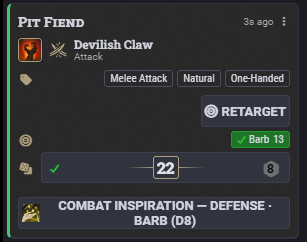
Valor · Combat Inspiration defense On an incoming hit, roll the granted Inspiration die from chat and add it to AC against that attack. This spends the granted die and leaves the recipient’s Reaction available.
Dance
Tandem Footwork. Select the checkbox in initiative configuration to spend one Inspiration and share its native die with eligible allies within 30 feet. Rolled allies keep their original dice; allies yet to roll receive the pending bonus.
Leading Evasion. The supported Dexterity save benefit extends to qualifying nearby creatures. Other movement and Dance choices remain manual.
Glamour
Beguiling Magic. Supported Charm/Fear effects prompt their end-of-turn repeat saves.
Mantle of Majesty. Activate through Unearthly Appearance to cast level-1 Command as a free Bonus Action and gain the concentration-linked buff. Later level-1 Commands use the free Bonus Action option; upcasts retain normal slot and action costs. Qualifying targets Charmed by that Bard automatically fail.
Unbreakable Majesty. A qualifying hit prompts Recoil; failure stops that attack. The feature tracks its per-turn restriction. Commanded is a reminder until the target’s turn ends; carrying out the command stays manual.
Spirits
Gather spirits. Giving Bardic Inspiration offers the native spirit roll. Gathered copies are tracked separately, including duplicates, until used or cleared by rest. Mystical Connection throws both dice together.
Spirits from Beyond. Choose Unleash Spirit, Controlled Channeling or Cancel, then confirm the spirit. Controlled Channeling spends its Bonus Action and Inspiration; Unleash uses the chosen gathered copy and the native spirit activity.
Empowered Channeling. Add the supported bonus in spell damage/healing configuration. Its Spirit Guardians option grants half cover through that modified casting’s area, including native free casting, while ordinary Spirit Guardians stays separate.
Moon
Inspired Eclipse. After giving Inspiration, activate the card control for invisibility and a visible, unoccupied teleport destination within 30 feet. The teleport does not consume movement.
Eventide’s Splendor. The Inspiration recipient gets an independent Eclipse option; their teleport uses a Reaction.
Lunar Vitality. In eligible healing configuration, choose Yes to spend Inspiration, No for the base healing, or Free with Eventide for 1d6 instead. One selected recipient receives the bonus and +10 Speed until their next turn ends. The shared once-per-turn limit still applies.
Blessing of Moonlight. Select it while casting Moonbeam to spend its use and gain the concentration-linked 5-foot dim-light buff. Each failed save against that casting offers its own 2d4 heal for another visible creature within 60 feet. Select the recipient and use the control; initial and later failures are supported, and Lunar Vitality can join the healing roll.
Bard card examples
Combat Inspiration · Defense. Combat Inspiration offers its defensive AC bonus directly on the incoming attack card.Bardic Inspiration on a failed attack. Add the granted Inspiration die to a failed attack while keeping the original roll.
Cleric
Core Cleric
Channel Divinity. Divine Spark uses native scaling and consumption. Turn Undead and Sear Undead are separate activities, each with a caster-centered target picker for Undead within 30 feet.
Blessed Strikes · Divine Strike. Eligible weapon hits offer a choice of Radiant or Necrotic bonus damage in damage configuration. Improved Divine Strike uses the higher native damage when available.
Blessed Strikes · Potent Spellcasting. The native feature adds the Wisdom bonus to Cleric cantrip damage. After qualifying cantrip damage is applied, Improved Potent Spellcasting offers a temporary HP action for yourself or a creature within 60 feet, once per cast.
Light
Warding Flare. React to eligible attacks from their cards, preserving the original roll. Improved Warding Flare offers its native temporary HP before incoming damage continues.
Corona of Light. Activate the attached enemy-only area and bright light. Its qualifying saves receive the supported Disadvantage benefit with normal cancellation.
Arcana and Knowledge
Modify Magic. Fortifying Spell requires a recorded friendly spell target; Tenacious Spell reduces an eligible successful enemy save. Availability is captured for the casting, with Channel Divinity checked on use.
Manifest Magical Knowledge. The Consumption checkbox appears for eligible prepared Divination spells on the Knowledge domain list. Select it to replace spell-slot consumption with Channel Divinity.
Grave
Circle of Mortality. Pull of Death adds the native scaling die in damage configuration against wounded creatures. Eligible spell healing against a 0-HP target uses maximum healing dice. Return to Life cantrip handling remains manual.
Path to the Grave. Apply the native curse and use its separate rider on a qualifying hit. Choose Radiant or Necrotic in damage configuration; the curse is removed without blocking the main damage workflow.
Sentinel at Death’s Door. React before damage is rolled when a Bloodied friendly creature within 60 feet is hit. Halve that hit’s damage before Resistance.
Divine Reaper. Enhanced Necromancy can add a second target to qualifying domain or single-target Necromancy spells. Self-only spells keep native range; material costs per target remain manual. Keeper of Souls stays manually activated with its native charge linked.
Life
Blessed Healer. After a qualifying slot-funded spell restores HP to another creature, the Cleric receives the feature’s native self-healing.
Disciple of Life and Supreme Healing. The healing roll shows the native slot-based bonus and maximizes eligible healing dice when Supreme Healing applies.
Preserve Life. Place the area, then allocate the feature’s healing pool among friendly recipients using the healing sliders.
Trickery and War
Invoke Duplicity. Supported illusion positioning supplies attack advantage for the Cleric, expanding to allied attackers with the improved feature. Summoning, movement and Healing Illusion remain native/manual.
Guided Strike. An eligible missed self/allied attack offers +10 using Channel Divinity. Assisting another creature uses a Reaction; the original dice remain visible.
Druid
Core Druid
Primal Strike and Potent Spellcasting. Choose the native elemental damage type on eligible hits, including Wild Shape attacks. The module uses Improved Primal Strike when available. Potent Spellcasting’s Wisdom bonus comes from the native feature.
Wild Shape and Beast Spells: Choose a beast and confirm to transform immediately. With Beast Spells, eligible prepared spells remain on the transformed sheet, while Moon spells keep their own access. Cast and concentrate in beast form, then revert without losing the concentration link. Spells with costly or consumed materials are excluded from Beast Spells access.
Summoned areas: Move your Conjure Animals pack and its area follows. Eligible creatures join the turn’s existing save and damage cards instead of starting another damage roll; successful saves take no damage. Once Conjure Elemental restrains a target, repeat saves and damage keep arriving until it breaks free.
Druid Circles
Circle of the Moon
Circle Forms. Confirm a beast in the native Circle Forms browser to transform immediately from the selection.
Improved Circle Forms · Lunar Radiance. Choose Radiant damage for an eligible Wild Shape attack in damage configuration. The module remembers your choice and keeps separately typed damage riders intact.
Moonlight Step. Applies Advantage to your next eligible attack and clears the effect after use.
Lunar Form. Offers its native bonus Radiant damage on a Wild Shape hit, once per turn.
Circle of the Land
Circle of the Land Spells. Choose your land at Long Rest. The module updates prepared spells through the native land choice.
Land’s Aid. Confirm the creatures to damage and choose one ally to heal in the same targeting window.
Natural Recovery. Choose expended spell slots at Short Rest. The slot choices stay within the remaining recovery budget.
Nature’s Ward. The Long Rest land choice activates its matching native resistance effect when you have this feature.
Nature’s Sanctuary. A friendly-only Region grants Half Cover and your active Nature’s Ward resistance, when available. Those benefits are removed when an ally leaves the area.
Circle of the Sea
Wrath of the Sea. Activate the manifestation and choose a creature within its native range for the initial save and damage. Later Bonus Action bursts are available from chat. Move pushed creatures at the table.
Stormborn. The active manifestation applies the native flight and resistances when the feature is available.
Oceanic Gift. Choose an eligible ally to bear the manifestation. The module tracks each bearer and prompts their owner or the GM for later bursts.
Circle of the Stars
Starry Form. Choose Archer, Chalice, or Dragon when spending Wild Shape. The module manages the active native constellation and clears it when the form ends.
Archer. Activating Archer offers the initial shot. Later shots are available as Bonus Action prompts at the start of your turn.
Chalice. Eligible healing casts offer a follow-up action in chat so you can choose who receives the extra healing.
Twinkling Constellations. Offers a form swap at the start of your turn. Constellation upgrades use the native feature.
Cosmic Omen. Roll Weal or Woe after a Long Rest. Use the Druid’s Reaction, native die, and a charge on an eligible attack or save from chat. Initiative support uses the same omen.
Dragon’s roll benefits and Full of Stars’ resistances come from the native features.
Fighter
Core Fighter
Indomitable. A failed save offers Indomitable right there. Reroll with the Fighter-level bonus and let the card update to the new result.
Studied Attacks. Miss a creature and the next attack against it offers Advantage. The module remembers the target and clears the benefit when used or expired.
Great Weapon Fighting and Great Weapon Master are under Feats. Other maneuvers remain manual.
Battle Master
The menu shows the maneuvers the Fighter knows and uses their current Superiority Die as they level up. Choose one for the attack, roll its damage with the weapon and let the module keep track of the spent die.
Precision Attack Add the current Superiority Die to a missed attack from chat. If it becomes a hit, check eligible defenses before damage.
Trip Attack Choose Trip with your weapon damage. The extra die joins the hit and the target makes its Strength save; failure knocks an eligible creature Prone.
Disarming Attack Choose it in damage configuration to add the native Superiority Die and prompt the target’s Strength save. On a failure, choose and drop the held object at the table.
Distracting Strike Add your maneuver damage and create an opening for an ally. The next eligible attack receives Advantage, then the opening clears.
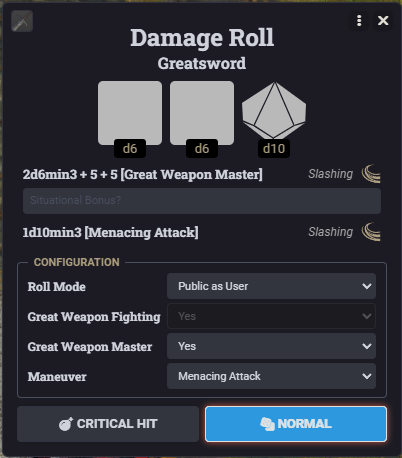
Menacing Attack Add the maneuver to your hit and prompt the target’s Wisdom save. A failure applies Frightened with the Fighter’s duration tracked for you.
Goading Attack Hit, add the maneuver damage and challenge the target. A failed save makes its attacks against other creatures suffer Disadvantage until the effect ends.
Maneuvering Attack Add the Superiority Die to damage and leave a visible reminder to choose an ally and resolve their Reaction movement.
Pushing Attack Roll the extra damage and Strength save together in the attack flow. On a failed save, the card reminds you to move the target away; token movement stays manual.
Relentless Choose whether to spend your usual Superiority Die or use the free Relentless d8. The module tracks that free use each combat turn, including qualifying reactions, and offers it when ordinary dice run out.
Cards, effects, and settings Maneuver choices stay visible on their cards, and applied effects can be undone and reapplied. Turn individual automations on or off in the Fighter settings.
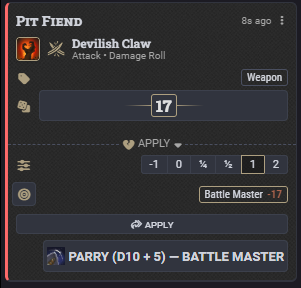
Parry Use Parry after melee damage is visible. Spend a Superiority Die and Reaction to reduce the damage before application.
Psi Warrior
Psionic Strike. After a qualifying weapon hit deals damage, click Psionic Strike to roll its extra Force damage. Your Energy Die and once-per-turn use are tracked.
Psionic Strike critical damage. A separate setting lets the bonus damage benefit from the triggering critical hit.
Telekinetic Thrust. Using Psionic Strike with Telekinetic Adept? Choose damage alone, Prone or Push in its window. The save follows without another Energy Die; move pushed creatures manually.
Protective Field. At the hit decision, reserve the Psi Warrior’s Reaction to protect yourself or an eligible ally. The native Energy Die reduces that creature’s linked damage once it is rolled.
Native and manual benefits. Keep using Bulwark of Force’s usual controls. Its cover works with supported cover modules without adding the AC bonus twice; situational choices remain at the table.
Champion
Survivor · Heroic Rally. A Bloodied Fighter who is still standing receives a healing roll at turn start. The owner can roll it from the prompt, or the table can choose immediate rolls in settings.
Arcane Archer
Activate shots manually. Choose and activate your Arcane Shot from its feature card after the attack. Shot selection, Curving Shot and adding the shot’s damage remain manual.
Effects finish on time. Banishing, Shadow and Enfeebling effects end when they should, and Enfeebling’s damage reduction uses the originating Fighter’s die.
Grasping Shot. A creature caught in the brambles gets a turn-start action reminder for its escape check. A new shot replaces that archer’s previous brambles; movement decisions remain manual.
Banneret
Group Recovery and Team Tactics. Activate the feature and pick allies from a list linked to the map. The picker handles range and recipient limits, and Team Tactics applies the group’s temporary Advantage.
Shared Resilience. An ally’s failed save offers the Banneret a Reaction. Use Indomitable to reroll it with the Fighter-level bonus, spending the appropriate use and updating the result.
Other Fighter features. Continue using the usual feature cards for Tactical Mind, Eldritch Knight choices and other situational actions.
Fighter card examples
Maneuvers in damage Configuration. Select Menacing Attack alongside your weapon benefits; its Superiority Die joins the initial damage roll.Parry on incoming damage. Spend an available Reaction and Superiority Die to reduce melee damage by the die plus your higher Strength or Dexterity modifier, keeping the original damage roll.
Monk
Core Monk
Uncanny Metabolism. Check it in initiative configuration when available. The completed roll activates its native feature card, restores Focus, spends the Long Rest use, and automatically rolls and applies its native self-healing. Canceling initiative spends nothing.
Deflect Attacks / Deflect Energy. Use Deflect at the hit decision before damage is revealed. The module uses the native reduction when damage is rolled, then offers the eligible redirect if the reduction brings damage to zero.
Disciplined Survivor. A failed save offers the Focus-funded reroll. Use it from the card and keep the replacement result.
Flurry of Blows. Follow a two-attack counter for Flurry, increasing to three with Heightened Focus. The module helps keep track of the strikes without extra bookkeeping.
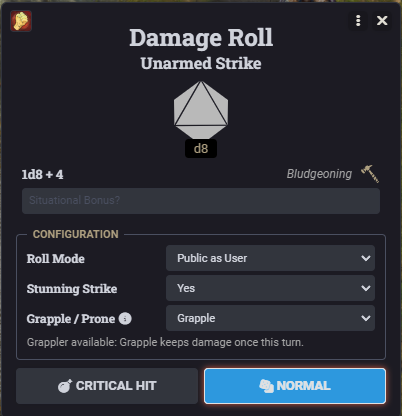
Stunning Strike Choose Stunning Strike while rolling a qualifying hit’s damage. The module spends Focus, tracks the turn’s use and prompts the target’s Constitution save.
Failed and successful saves A failed save applies Stunned. A successful save still applies the feature’s slowed movement and next-attack Advantage, with their durations tracked.
Stun before Grapple Choose both on the same hit and Stunning Strike resolves first. If the target is Stunned, its following Grapple save automatically fails.
Independent corrections Undo a Stunning Strike or Grapple effect and correct its save without having to undo the weapon’s damage too.
Shared Grapple / Prone prompts are under Common; Grappler’s feat benefits have their own Feats setting.
Open Hand
Flurry techniques. Choose supported Open Hand techniques alongside your Flurry damage and resolve the save or condition from the same attack flow.
Mercy
Hand of Harm. Add Hand of Harm to an eligible hit and spend Focus. The upgraded native activity applies Poisoned after damage. A separate setting lets Hand of Harm benefit from a triggering critical hit.
Hand of Healing. Replace a remaining Flurry attack with touch-range healing from the counter, without an additional Focus cost. A canceled healing roll leaves the attack available.
Flurry of Healing and Harm. Activate the feature before your first Flurry attack to unlock its extra healing substitutions and free Hand of Harm. The module spends the daily use and keeps the shared Harm limit in view.
Elements
Elemental Push / Pull. Choose an elemental push or pull with your damage roll and prompt the required save. Resolve the movement on the map.
Elemental Epitome. Choose the supported resistance and let it stay linked to the feature’s active benefits.
Destructive Stride. Use Step of the Wind and the feature’s speed boost and damaging aura follow for the turn. Enemies you encounter are collected on one damage card, with each creature hit once and no saving throw.
Empowered Strikes. Include the extra damage in the attack’s damage roll, with the once-per-turn use tracked.
Mystic Arts and manual choices
Focused Strike. After Stunning Strike resolves, the target has Disadvantage on saves against that Monk’s spells until the Monk’s next turn, whether or not the stun succeeded.
Leave movement and casting flexible. Use the normal controls for Mystic Arts spells and make situational movement choices at the table.
Monk card examples
Stun and Grapple in damage Configuration. This example also shows the Grappler feat: the prompt confirms that Grapple keeps the attack’s damage once on this turn. Without that benefit, Grapple replaces the damage.
Paladin
Core Paladin
On an eligible hit, open the strike’s Damage Configuration to choose Divine Smite or an available prepared Smite spell.
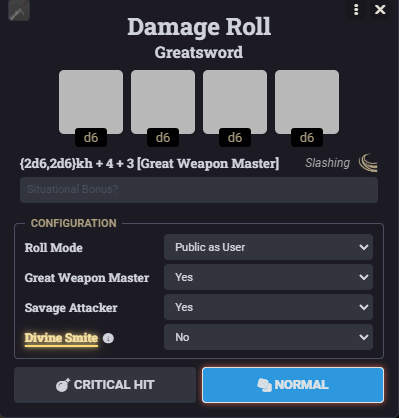
Divine Smite Choose to smite while rolling weapon damage. Pick the slot, see the extra dice and roll everything together, including the right critical damage.
Fiend and Undead bonus Strike a Fiend or Undead and the extra Smite die is included for you.
Prepared Smite spells Select an available Smite spell alongside the hit’s damage. Its slot or free use and Bonus Action are spent once, and the follow-up stays linked to that attack.
Saves and effects The chosen Smite prompts its required save and applies the appropriate effect. Ongoing damage and repeat saves follow the affected creature, while the damage card shows which Smite was used.
Paladin Auras
The module automatically creates a Region around each eligible Paladin. It moves with the Paladin and updates which allies receive Protection, Courage, and supported oath benefits.
Overlapping Auras of Protection grant one saving throw bonus. The strongest applies by default, and players can choose another available Paladin in their character sheet’s Paladin aura menu.
For Genie Paladins, choose one Elemental Shielding resistance from the native feature card to update the aura.
GM setup. Disable older Paladin emitters from Aura Effects and match the scene grid to the map. Aura outlines appear on the Regions layer.
Supported oath features
Noble Genies · Elemental Smite After Divine Smite, choose your elemental follow-up from the damage card. Depending on the element, restrain the target, gain defenses or choose enemies for extra damage or saves. The picker guides the extra targets and the feature use is spent once; forced movement and teleports remain manual.
Noble Genies · Elemental Rebuke On a confirmed hit, choose an element and use the Paladin’s Reaction before damage is applied. The module halves only the Paladin’s damage and prompts the attacker’s native Dexterity save.
Ancients · Nature’s Wrath Use the initial save and restraint as usual. At the victim’s turn end, the module prompts its escape save and removes that restraint on success.
Devotion · Sacred Weapon Activate Sacred Weapon from the attack window. Its attack bonus and light come on together, and the previous lighting returns when the effect ends or the weapon is unequipped.
Devotion · Smite of Protection Use Divine Smite and your aura grants its temporary Half Cover to you and nearby allies. Supported cover modules handle it without adding the same AC benefit twice.
Devotion · Holy Nimbus Activate Holy Nimbus to light the area, damage nearby enemies at their turn starts and gain supported saving-throw protection. Ending the feature clears its ongoing benefits.
Vengeance · Vow of Enmity Choose the marked enemy from the attack window and receive Advantage against it. When that creature falls to 0 HP, transfer the Vow without paying again or resetting its duration.
Vengeance · Avenging Angel Activate the form as usual. Enemies starting turns in the aura make their fear saves; failures receive Frightened and supported attacks against them gain Advantage. The fear clears on damage or when its duration ends.
Elder Champion, Noble Scion/Minor Wish, Soul of Vengeance, Relentless Avenger, Inspiring Smite allocation and Living Legend remain table-managed. Keep an active GM connected for managed operations.
Paladin card examples
Divine Smite in damage Configuration. Choose whether to smite alongside your other damage options. Smite damage follows the attack’s critical result.
Ranger
Core Ranger
Relentless Hunter. Keep concentrating on Hunter’s Mark without damage-triggered concentration rolls when this feature applies.
Precise Hunter and Foe Slayer. Attacks against your marked prey offer Advantage, and Foe Slayer upgrades the Mark’s damage die automatically.
Hunter’s Mark is grouped with Spells because its rider follows the caster’s concentration and marked target.
Hunter
Hunter’s Prey / Colossus Slayer Add Colossus Slayer while rolling damage against an injured target. The module remembers your choice, includes the right dice and tracks the once-per-turn use.
Choose during a rest. Choose Hunter’s Prey and Defensive Tactics during Short or Long Rest. Your current choices are shown, and the new benefits take effect when the rest finishes.
Defensive Tactics. The chosen defense recommends Disadvantage on the qualifying attacks. Escape the Horde follows the documented table interpretation for attacks during the Ranger’s own turn.
Superior Hunter’s Defense. React from the incoming damage card and pick the damage type to resist. A breakdown helps with the choice, and only the relevant damage is reduced.
Superior Hunter’s Prey. After damaging your marked creature, choose another nearby enemy to receive the same Hunter’s Mark damage. No second damage roll is needed, and the new target’s defenses still apply.
Beast Master
Bestial Fury. Your linked Primal Companion adds its supported damage against your marked prey. Keep choosing its commands and attacks as usual.
Gloom Stalker
Dread Ambusher · Dreadful Strike. Choose Dreadful Strike in weapon damage configuration. The module uses the eligible Dread Ambusher activity and its native shared charges.
Stalker’s Flurry. After choosing Dreadful Strike, choose Mass Fear for an area save or use Sudden Strike from the damage card. The fear duration is tracked for you.
Fey Wanderer
Dreadful Strikes. Extra Psychic damage joins qualifying hits, with each creature tracked separately so you can use it against different enemies in the same turn.
Beguiling Twist. Activate the feature, choose Charmed or Frightened, and resolve the save. Repeat saves arrive at turn end and clear the chosen condition on success.
Misty Wanderer. Misty Step gains a feature-funded casting option, so the player can spend a Misty Wanderer use instead of a spell slot. Companion placement stays manual.
Hollow Warden
Wrath of the Wild. Transform as usual and the fear aura follows your token. Nearby enemies make their saves when the aura is adopted and at your turn start; fear lasts until your next turn.
Hungering Might. A qualifying hit while transformed and Bloodied offers your healing roll. The module checks your actual HP and tracks the turn’s use.
Rot and Violence. The aura’s failed saves also block healing and Reactions. Strangling Roots lets you choose Sap or Slow alongside the weapon’s other mastery and remembers the choice.
Ancient Might. Attack a Frightened creature while transformed and the extra Wisdom damage is included automatically.
Winter Walker
Frigid Explorer. Choose Polar Strikes with your weapon damage. The module scales the Cold die and tracks each target, while Biting Cold lets qualifying attacks and spells bypass Cold resistance.
Hunter’s Rime. A fresh Hunter’s Mark cast offers your temporary HP roll, including free casts. Moving the existing Mark does not grant it again.
Fortifying Soul. Use the healing and hour-long protection as usual. Recognized saves against fear offer Advantage while it lasts.
Chilling Retribution. React to an attacker from its damage card and prompt its Wisdom save. On failure it is Stunned with no movement until your next turn ends; the triggering damage still applies.
Frozen Haunt. Activate the form while casting Hunter’s Mark and its Cold aura follows you. Nearby enemies receive its damage prompts on activation and your turn start, and the aura clears when the form ends.
Ranger card examples
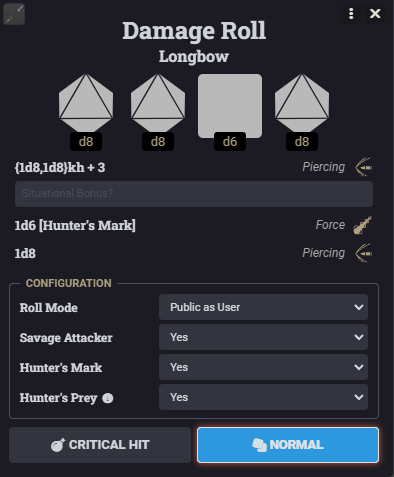
Track the mark. Add the damage. Hunter’s Mark and Hunter’s Prey appear alongside your other damage options, with their riders included in the initial roll.
Rogue
Core Rogue
Sneak Attack. Eligible attacks recommend Sneak Attack in the damage window. Confirm it to roll the extra dice with your weapon damage; the module tracks the use, and you can select it yourself when a situational rule applies.
Cunning Strike. Trade Sneak Attack dice for Poison, Trip or Withdraw while rolling damage. The window handles the dice cost and later upgrades; supported saves, conditions and repeat saves follow through. Move for Withdraw manually.
Devious Strikes. Choose Daze, Obscure or Knock Out with the appropriate Sneak Attack cost. The module prompts saves, tracks durations and handles waking on damage where appropriate.
Uncanny Dodge. At the hit decision, spend your Reaction to halve the linked damage before it is revealed. Critical hits can qualify.
Evasion. Qualifying Dexterity saves apply no damage on success and half on failure. The save summary identifies Evasion so the GM can see why the damage changed.
Assassin
Assassinate. First-round attacks offer the feature’s Advantage against eligible enemies, and qualifying Sneak Attacks include the Surprising Strikes bonus.
Envenom Weapons. Failed Cunning Strike Poison saves offer the extra Poison damage, including repeat failures. Poison resistance is bypassed; immunity still protects the target.
Death Strike. A qualifying first-round Sneak Attack prompts the extra save before HP is applied. A failure doubles the damage without asking you to roll the original damage again.
Soulknife
Homing Strikes. A missed Psychic Blade offers the extra Psionic die on its card. Spend the die only if it turns the miss into a hit, then continue to damage.
Rend Mind. Choose Rend Mind after qualifying Psychic Blade Sneak Attack damage. The module uses the available free use or appropriate dice, then handles the Stunned effect and repeat saves.
Thief, Scion and manual subclasses
Thief’s Reflexes. The Thief receives a second initiative entry in round one, ten counts lower. It follows the same token and disappears after that extra turn.
Scion of the Three · Terrify. Choose Terrify through Cunning Strike, trade the Sneak Attack die and prompt the fear save. Frightened and its repeat saves are handled for you.
Leave one-off choices manual. Keep using the normal feature cards for unsupported subclass choices and situational targeting.
Sorcerer
Core Sorcerer
Font of Magic. Convert spell slots and Sorcery Points in one picker that tracks the resources available.
Sorcerous Restoration. Choose eligible Sorcery Point recovery during a Short Rest.
Innate Sorcery. The native feature supplies attack Advantage. Its active state also enables supported Metamagic and subclass options.
Sorcery Incarnate. The casting prompt allows two eligible Metamagic options while Innate Sorcery is active.
Arcane Apotheosis. The prompt tracks the available free Metamagic use on your turn while Innate Sorcery is active.
Metamagic
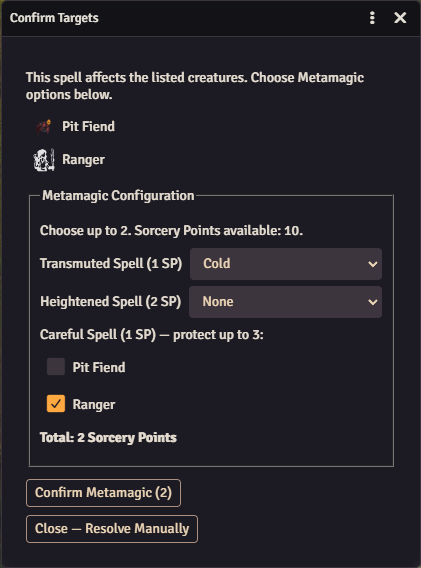
Choose eligible options during casting. The prompt shows the Sorcery Point cost and asks for any extra targets or damage types. Reaction spells skip this prompt.
Transmuted Spell. Choose a new damage type for eligible spell damage.
Heightened Spell. Choose the target that gets Disadvantage on its save.
Careful Spell. Choose creatures to protect from the spell.
Quickened Spell. Cast an eligible Action spell as a Bonus Action and track the Bonus Action use.
Twinned Spell. Add an eligible second target and resolve both targets through the same cast.
Subtle Spell. Declare it and spend the Sorcery Points in the casting prompt. Handle component changes at the table.
Distant Spell. Declare it and spend the Sorcery Points in the casting prompt. Handle the range change at the table.
Extended Spell. Declare it and spend the Sorcery Points in the casting prompt. Handle the duration change at the table.
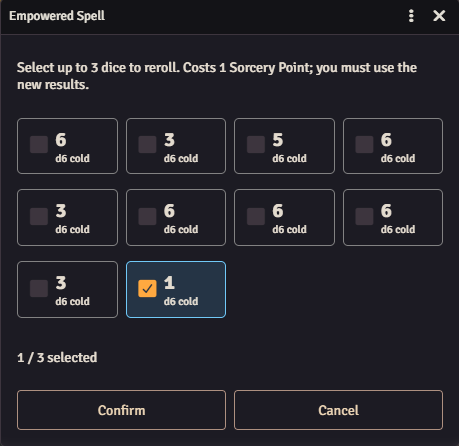
Empowered Spell. Select eligible dice to reroll once spell damage is visible.
Seeking Spell. Reroll an eligible missed spell attack from chat before damage.
Sorcerer Subclasses
Aberrant Sorcery
Psychic Defenses. Applies Advantage to eligible saves against Charmed or Frightened.
Psionic Sorcery. Choose Sorcery Points or a spell slot when casting eligible Psionic Spells.
Revelation in Flesh. Choose which benefits to activate and review their total Sorcery Point cost in one window.
Warping Implosion. Choose how to pay, resolve the burst around your departure point, and use the supported teleport placement.
Clockwork Sorcery
Restore Balance. Spend your Reaction to remove Advantage or Disadvantage on an eligible roll. On attacks, the option appears at declaration.
Bastion of Law. Choose the ward’s recipient. Once incoming damage is visible, roll available ward dice to reduce it without spending a Reaction.
Trance of Order. The module manages activation and payment and prevents incoming attacks from gaining Advantage. The native feature supplies the minimum D20 result.
Clockwork Cavalcade. Choose recipients and divide the native healing pool among them.
Draconic Sorcery
Elemental Affinity. The native feature supplies the chosen resistance and spell damage bonus.
Shadow Sorcery
Strength of the Grave. Chat offers a recovery action when recorded damage drops you to 0 HP.
Beasts of Ill Omen. The summoned beast carries an aura that penalizes eligible enemy saves against your spells.
Umbral Form. Choose it when activating Innate Sorcery. The module handles the feature use or Sorcery Point cost.
Shadow Walk is handled at the table.
Spellfire Sorcery
Crown of Spellfire. Choose it alongside Innate Sorcery and use its available free activation or Sorcery Point cost.
Burning Life Force. Choose Hit Point Dice from the damage card to reduce your incoming damage.
Spell Avoidance. Applies the feature’s damage adjustment on qualifying magical saves that normally deal half damage on a success.
Wild Magic Sorcery
Tides of Chaos. Choose it in D20 configuration. A setting controls whether a qualifying slot-funded spell attack can trigger its surge from the same cast.
Wild Magic Surge. Roll the surge from chat. The result offers a supported effect or reminder, with Undo for applied effects.
Bend Luck. Spend a Reaction and Sorcery Points to adjust an eligible attack or saving throw without rerolling the original dice.
Controlled Chaos. Roll two surge results and choose which one to use.
Tamed Surge. Open a picker to choose a surge result.
Sorcerer card examples
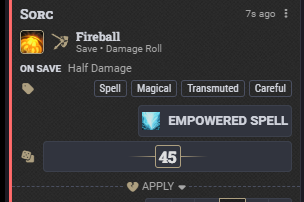
Empowered Spell on the damage card. Use the Empowered Spell action on the spell’s damage card. Tags keep the casting’s Metamagic choices visible.Choose the dice to reroll. Select eligible damage dice up to the displayed limit, then confirm to spend 1 Sorcery Point. The new results must be used.Metamagic choices, kept with the spell. This earlier example shows the available decisions; the current window uses compact option dropdowns. Choose an element, select a Heightened target, or protect allies with Careful Spell. Available Sorcery Points, supported combination limits, and the total cost stay visible before confirming.
Warlock
Core Warlock
Pact Magic and Magical Cunning. Use the native slot and recovery controls. For Celestial Warlocks, completing Magical Cunning can also distribute Celestial Resilience temporary HP.
Eldritch Blast. The module tracks the remaining beams from one cast. Each beam keeps its own target, attack, damage, and chat controls.
Hex. Use the curse card to change the affected ability. On eligible hits against the marked target, the bonus damage joins the weapon or spell damage roll.
Eldritch Invocations
Eldritch Smite. Choose it in Damage Configuration on an eligible Pact of the Blade hit. It spends a Pact Magic slot, scales the Force damage with that slot, and tracks the once-per-turn use.
Lifedrinker. Choose the bonus damage type on an eligible Pact Weapon hit. The completed damage card can also offer self-healing from an available Hit Die.
Investment of the Chain Master. Choose a supported damage type for the familiar. After incoming damage is visible, the Warlock can spend a Reaction to give the familiar Resistance before application.
Warlock Patrons
Archfey
Steps of the Fey. Choose Refreshing Step or Taunting Step when casting Misty Step. Chat guides the recipient or target selection for the chosen effect.
Misty Escape. Choose Disappearing Step or Dreadful Step on eligible Misty Step casts. Dreadful Step offers targets around the departure or arrival point.
Beguiling Defenses. On an incoming hit, use a Reaction to halve the linked damage and prompt the attacker’s Wisdom save. A failed save returns Psychic damage based on damage actually taken. A Pact Magic slot can restore an expended use.
Celestial
Radiant Soul. Adds its bonus to qualifying spell damage.
Celestial Resilience. Choose allies during Short Rest, Long Rest, or Magical Cunning. Finishing the activity grants the native temporary HP amounts to the Warlock and selected allies.
Searing Vengeance. Choose yourself or one eligible ally at 0 HP. The feature heals that creature and centers its enemy damage and Blinded effect on them.
Fiend
Dark One’s Blessing. Grants temporary HP when you defeat an enemy or an enemy falls within range.
Dark One’s Own Luck. Add the native bonus die to an eligible ability check or failed save, spending a feature use while keeping your Reaction available.
Fiendish Resilience. Choose a resistance at rest and the module applies it.
Great Old One
Psychic Spells. Choose Psychic damage for eligible Warlock spells. The module remembers your choice.
Clairvoyant Combatant. A failed save applies the attack Advantage and Disadvantage tied to that specific Awakened Mind target.
Eldritch Hex. Choose the affected ability from the Hex card. The curse applies Disadvantage to both checks and saves for that ability while keeping concentration and bonus damage linked.
Thought Shield. Offers its reflected Psychic damage after you take Psychic damage.
Create Thrall. Choose the shorter, concentration-free Summon Aberration option. The summon receives its native temporary HP and can deal bonus Psychic damage to the Warlock’s Hex target.
Undead
Form of Dread. Tracks Superior Dread with the active form. Frightful Avatar appears in damage configuration for eligible hits and prompts the target’s save.
Grave Touched. Handles eligible Necrotic damage choices, Arcane Necrosis resistance bypass, and Dreaded Necrosis bonus damage on qualifying Form of Dread hits.
Vestige
Semblance of Life. Transforms the existing Vestige companion into its stronger spirit form. Its HP, Hit Dice, and Divine Power are retained. The form ends when its temporary HP runs out or its time expires.
Companion turns. A linked Vestige without its own combatant follows the Warlock’s turn for native item recovery, effect expiry, and its own Reaction and Bonus Action resets. This also works during Semblance of Life.
Wizard
Core Wizard
Arcane Recovery: Select expended level 1–5 slots during Short Rest. The dropdowns share the Wizard’s recovery budget and narrow as you choose. Completing the rest recovers the selected slots and spends the feature use; canceling or choosing nothing spends nothing.
Spell Mastery: Mark spells with the native Mastered enchantment. At base level, Consume Spell Slot starts unchecked. Selecting an upcast level checks it; returning to base level unchecks it. You retain native manual checkbox control.
Signature Spells: Use Make Signature to mark the two spells. Each gets one charge, recovered on Short or Long Rest, and a separate Signature Cast/Use activity that casts at base level and spends that charge. The original activity stays ready for normal slot casting and upcasting after the free use is spent.
Item enchantments: Choose their inventory recipient through the enchantment card without an unrelated map Retarget button.
Evocation and Abjuration
Sculpt Spells. Choose supported friendly protection during area-target confirmation.
Potent Cantrip, Empowered Evocation and Overchannel. Supported miss/save damage, the one-roll Intelligence bonus, and optional maximum spell dice appear in the spell workflow. Overchannel tracks its native use and escalating self-damage.
Arcane Ward and Projected Ward. Arcane Ward uses the native ward pool and handles supported creation, recharge, and damage absorption. On a hit against an eligible ally, Projected Ward offers the Abjurer’s Reaction before damage is shown. Undo restores linked ward and HP changes.
Spell Resistance. Supported spell saves recommend Advantage with normal cancellation; native resistance handles spell damage.
Bladesinger and Conjuration
Bladesong and Song of Defense. Bladesong supplies supported weapon benefits. Once incoming damage is visible, Song of Defense offers a choice of spell slot before spending it and the Wizard’s Reaction to reduce damage.
Durable Summons and Focused Conjuration. Supported slot-funded Conjuration summons gain their native benefits; qualifying Conjuration concentration avoids damage-triggered checks.
Splintered Summons. Choose the supported extra summon while casting, with native use consumption and concentration cleanup.
Divination, Enchantment and Illusion
Portent and Third Eye. Long Rest offers a private Roll Portent reminder. Supported Third Eye benefits clear on Short or Long Rest.
Hypnotic Presence and Instinctive Charm. Supported effects retain source-specific range/damage expiry, while eligible incoming hits offer Charm and its save/retarget flow. Qualifying Enchantment casts recharge the feature.
Split Enchantment and Illusory Self. Eligible Enchantment spells gain the supported extra target. Illusory Self offers its Reaction on a qualifying attack.
Mirror Image. This shared spell automation applies the native duplicates. On an eligible hit, use the chat action to roll for interception without spending a Reaction.
Necromancy and Transmutation
Undead Vitality and Grave Power. Use supported Undead healing and Necrotic resistance handling from the feature’s native setup.
Extinguish Undead. Eligible defeated Undead offer source-aware actions with the appropriate resource/Reaction cost and native area damage.
Transmuter’s Stone. Choose supported benefits after Long Rest and retain one source-tracked stone effect.
Empowered Transmutation and Master Transmuter. Choose enhanced native scaling while casting, or use supported Panacea, Restore Life and Restore Youth actions. Major Transformation, age changes and cursed-item decisions remain manual.